Introducing the CNTR AISLE Portal: Making Sense of AI Policy
Introduction
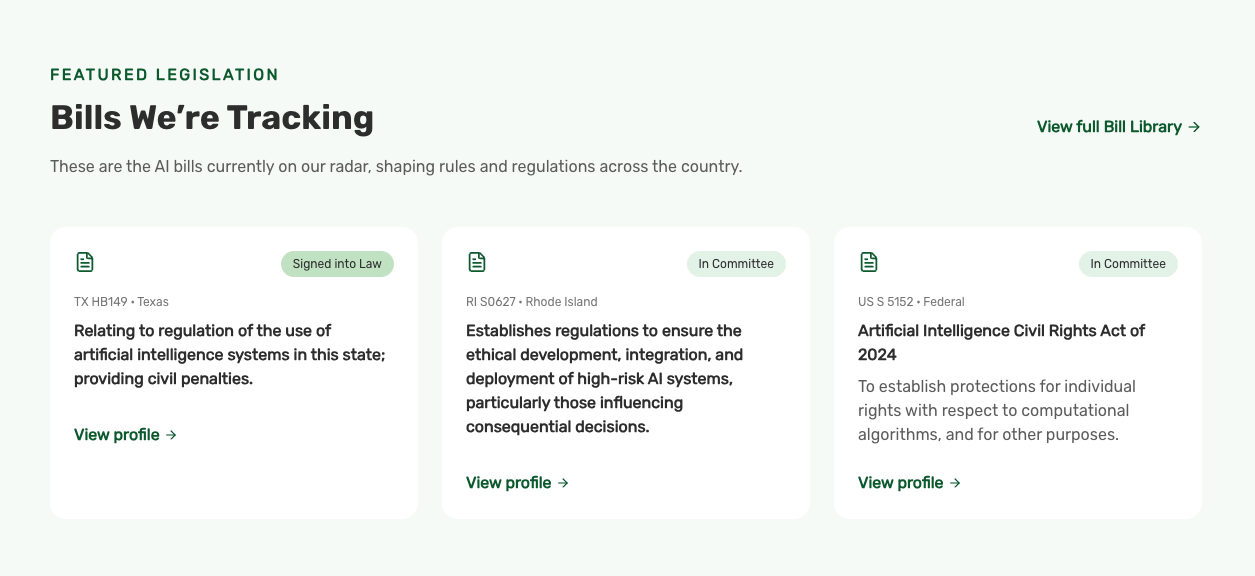
Today we are launching the CNTR AISLE Portal, a new way for the public to make sense of the complicated landscape of AI-related legislation across the United States. Over the last three years, over 1000 AI-related bills have been introduced in the U.S. With AISLE, we will help the public, journalists, researchers, and policymakers identify key policy trends and assess the maturity of these proposals. The public-facing portion of our Portal features two new products that help address this goal: the Bill Library and Bill Profiles. Our Bill Library aggregates the AI-related bills that have been proposed in a way that is easy to navigate for those interested in finding them. The Bill Profiles act as a quick reference to summarize the key aspects of the bill and are powered by questionnaire responses from policy analysts. For our initial launch, the Bill Library contains over 5,000 bills, approximately 100 of which have been evaluated. All evaluated bills have Bill Profiles associated with them.
The Challenge
Before we dive deeper into the products launching today, we’d like to share our motivation and vision for this project, including how it evolved over time, and how we decided we needed to create the tools that we are showcasing today.
We started the CNTR AISLE project in 2023 as we saw many pieces of AI legislation being introduced in state houses across the country. States had started to take action on topics ranging from facial recognition, to data privacy, to AI accountability, and so much more. Some of these bills were substantial and targeted. Some bills didn’t have much in them beyond the word “AI” in the title.
It was clear that we needed a way to make sense of the rapidly evolving landscape of AI legislation and provide a picture of the current state of affairs around AI policymaking. We wanted to help people understand what kinds of bills were being proposed and on which topics. This allowed us the opportunity to study how the process of AI policymaking was evolving over time. It was also clear that the audience for this sense-making wasn’t limited to a few. It was broad and included policymakers, legislators, the media, researchers, advocates, and the public.
Our initial goal was to build a policy-driven neutral framework for analyzing individual bills in a way that we could compare different bills, different versions of the same bill, or even the collective evolution of bills over time. We chose to avoid grading bills, which may be misinterpreted as in favor of one proposal or another. In contrast, we intentionally designed a framework to identify relevant elements of AI legislation, allowing for an open and transparent evaluation of how individual bills address various aspects of policy.
The Team
Since the inception of this project, the team has consisted of a highly interdisciplinary mix of undergrads, grad students, staff, and faculty. Originally, the team was a small research group largely focused on policy, developing the framework and its dimensions, with refinement over time. The team eventually grew to include CNTR faculty and staff members, external affiliates, graduate student volunteers, and undergraduate students. These 14 undergrads come from different concentrations, such as computer science, international and public affairs, math, english, sociology, behavioral decision sciences, and cognitive science.
This endeavor would also not be possible without the dedicated members of our inaugural cohort of the AISLE Legislation Lab, which consists of 17 undergraduate student evaluators and 5 graduate student evaluators. These evaluators are the ones who read bills and fill out the questionnaires, and their responses comprise the dataset upon which the rest of the AISLE products are built.
The Opportunity
We developed an initial version of this framework last year, and were able to identify many useful insights from a selected number of bills. We also tracked trends and meta-trends in more than one thousand bills that had been introduced in the period from 2023 to 2025.
Since the inception of AISLE, the policy team has been developing the questionnaire used to construct the bill profile. They decide what topics to cover, which bills to review, how to construct questions that explore different aspects of the bills, and how to evaluate them. Internal review and testing by the entire AISLE team further informs the policy team how to refine the questionnaire.
We eventually realized that we needed a richer infrastructure for organizing and carrying out all of this research. In addition to the process we had developed for our policy analysis, we needed sophisticated data engineering to collect and process the bills that continued to come in rapidly. The data engineering team collects bill data from trackers and other sources, cleans up the text for analysis, and even (right now) is exploring all kinds of AI enhancements to distill insights from bills.
We also recognized the significant educational and research potential of this work. While developing our bill profiles and questionnaire, our team of mostly undergraduate students gained deep expertise in legislative analysis and AI policy and how different states across the country approached the same topic. Many have since transitioned into professional roles; for instance, one alumnus is now a full-time tech policy analyst, while another is completing law school. As a result, the project now equips student researchers with the skills and knowledge to critically examine tech policies while creating a space for them to collaborate and iterate on the framework together.
And finally, it was vital that our work be transparent and replicable in such a way that others could adapt and build off our work. We hope to provide a model for others to do the same in similar settings. Our dataset will be publicly available and open for anyone to analyze, a level of transparency we believe is both highly beneficial and particularly appropriate for an academic group.
Recognizing the importance of a user-friendly, public-facing interface for people to review and evaluate bills through our AISLE framework, our product team has built a website, an evaluation interface for analysts, and a sophisticated backend that will allow us to publish both raw data and more in-depth analyses.
Our Solution: The CNTR AISLE Portal
The CNTR AISLE Portal has three distinct parts, two which are public-facing and one that is for internal use only.
Bill Library
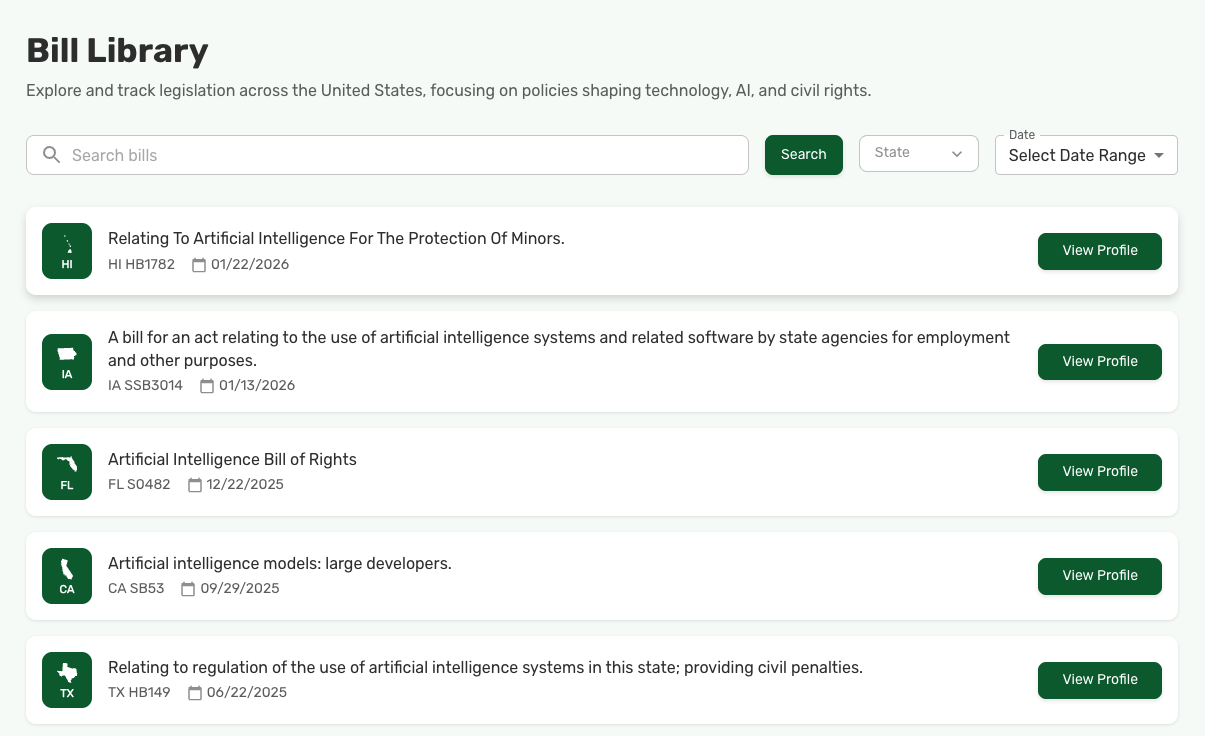
The publicly available Bill Library offers an interface to browse our curated selection of policies pertaining to AI. Users can search for specific keywords, and also have the option to filter for specific jurisdictions and range of introduced dates. Users can navigate to entries of interest to further inspect Bill Profiles.
Bill Profiles
The Bill Profiles are a user-friendly way to understand the results of our evaluations. The results from our human evaluations are integrated and rendered in a Bill Profile for each bill. Each Bill Profile also displays general information about the bills integrated from the data engineering workstream, including titles, jurisdictions, introduced dates, and a summary.
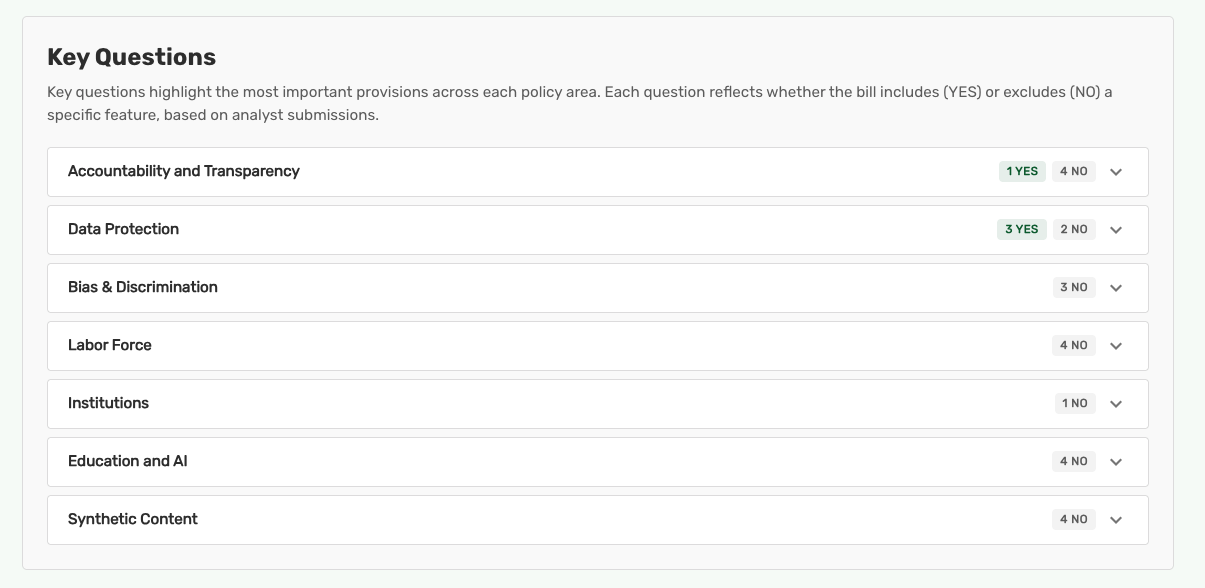
The example Bill Profile below is from HB 1782 from Hawaii: “Relating To Artificial Intelligence For The Protection Of Minors”. Bill Profiles provide a quick understanding of how the bill of interest varies across the six dimensions that we evaluate on. Based on the AISLE Framework, the Hawaii example bill below contains many pronounced Data Protection components, as well as some Accountability components. One particularly important Data Protection component in this bill is the establishment of a private right of action.
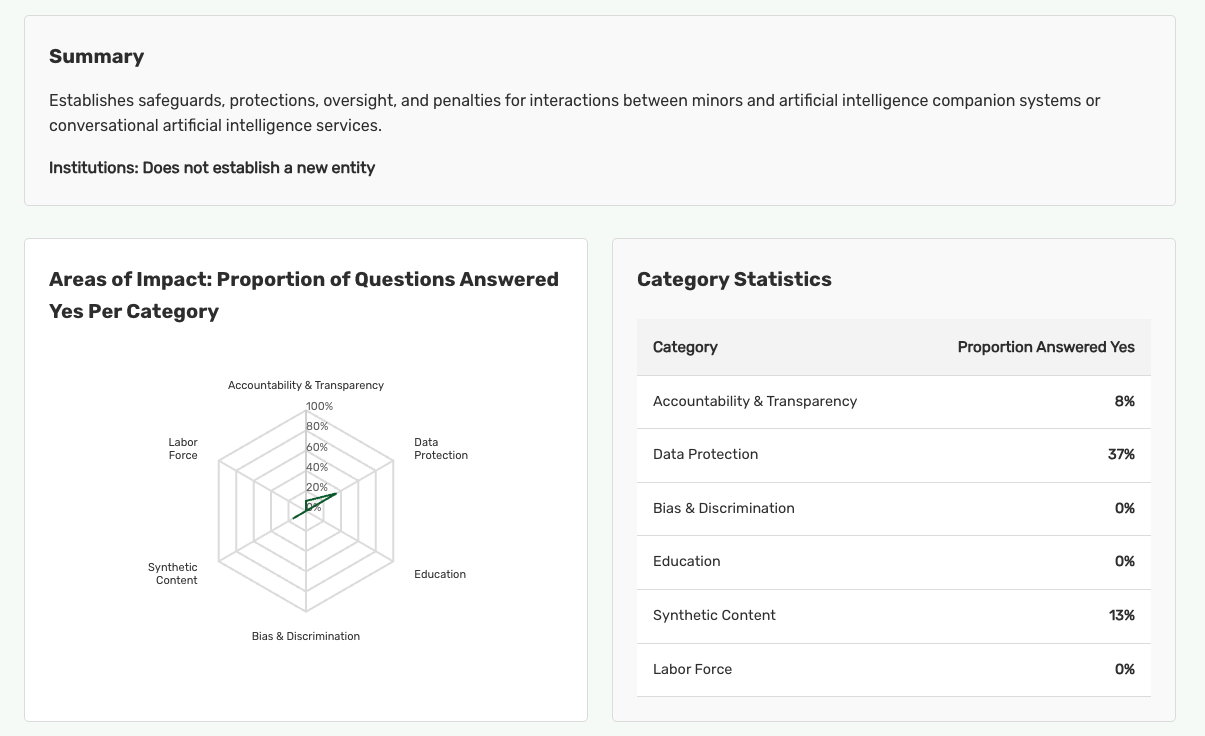
Bill Profiles includes coarse quantifications across our framework dimensions and highlighted present components of the most prominent dimension for that bill. The selection of the highlighted “Key Questions” is from our own determination, consisting of components that we believe are most important to their dimension of evaluation.
Bill Portal
The Bill Portal allows administrators to manage bill assignments and monitor evaluation progress. From the evaluator’s perspective, the Portal provides an interface to easily evaluate their assigned bills by answering the questionnaire that comprises the AISLE Framework.
As this contains private information from our evaluators, the Portal is only accessible to our team and approved evaluators. However, we will make the complete questionnaire public in the Portal, currently consisting of 158 total number of questions, most of which being Y/N, and spanning seven categories. (Version one of the questionnaire is currently available in GitHub.)
A Living Framework
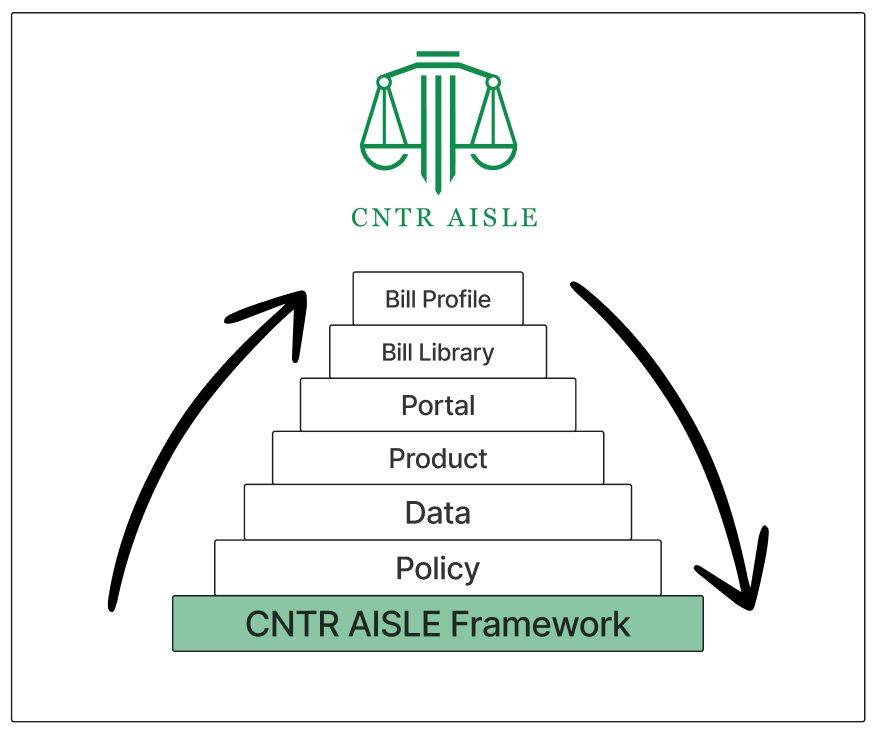
Ultimately, the AISLE Framework serves as the foundation for everything we have built. The value of the CNTR AISLE platform is amplified through a continuous feedback loop that bridges the gap between research and product. These elements compound and enhance one another: our rigorous policy analysis informs our data collection, while the resulting data inspires new product features. As we continue to refine both the framework and these tools, we welcome feedback and collaboration to ensure the Portal remains a vital resource for making sense of the AI legislative landscape. Please contact us at CNTR-AISLE@brown.edu.