Flipping the Script on AI in Newsrooms
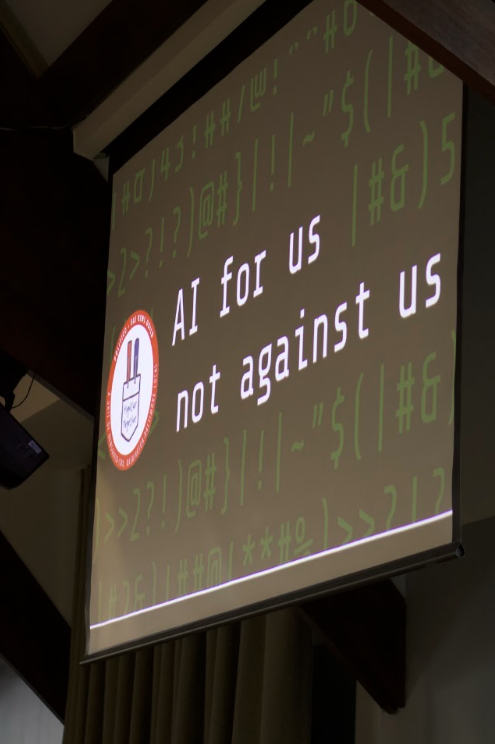
On April 30th, 2026, we brought together around 40 journalists, researchers, technologists, and organizers at Brown for a day-long workshop centered around a key question: what would it look like for newsrooms to use AI on their own terms?
The need is clear: AI is rapidly permeating journalism, increasing dependency on a few Big Tech companies who control much of the infrastructure underpinning commercial AI. Many in the industry have raised alarms about what this means for editorial independence, labor, and the long-term viability of journalism itself.
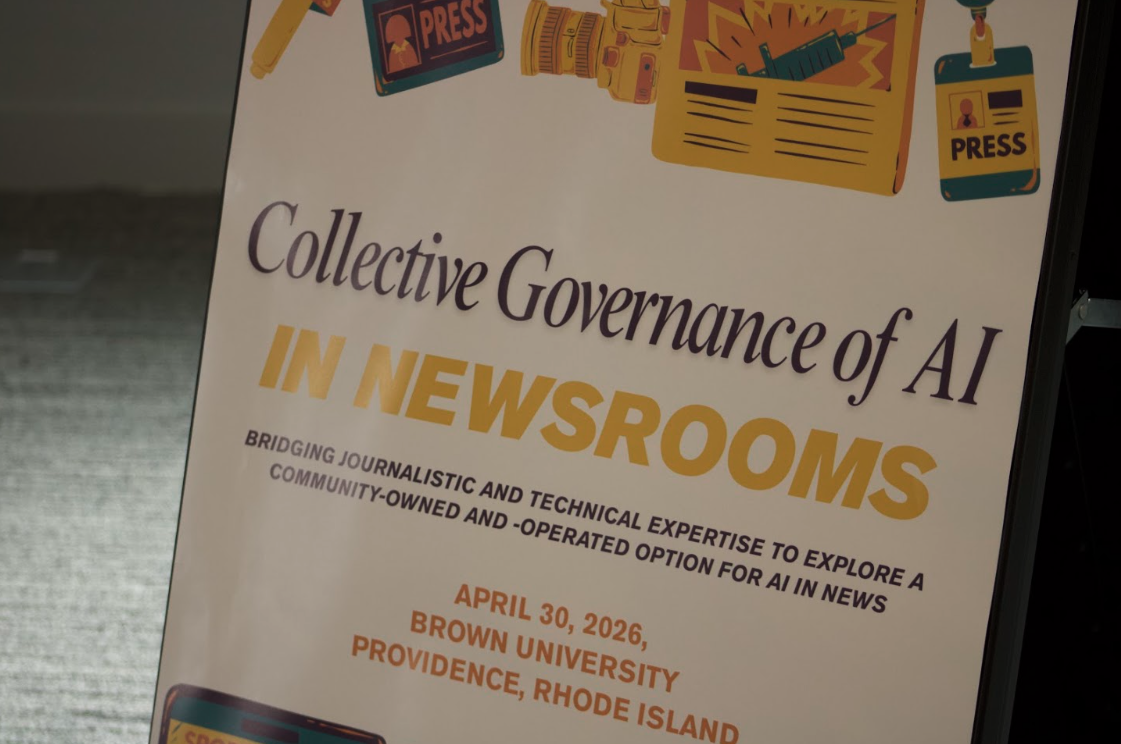
This workshop grew out of several years of research on participatory AI governance by the organizing team: Harini Suresh (Brown University), Emily Tseng (University of Washington), Marianne Aubin Le Quéré (University of Illinois at Urbana Champaign), and Aimee Rinehart (Frontier Collective).
In 2024, we wrote about how meaningful participation and accountability in AI requires domain-specific interventions. While efforts at the level of general-purpose foundation models often hit a “participatory ceiling,” getting specific about context allows us to more tractably bring together key stakeholders to collectively define and control how AI should be used. In 2025, we explored this idea in the context of journalism, interviewing around 20 newsroom stakeholders in both small and large newsrooms across the US. We found real appetite for an AI option outside of Big Tech, alongside important tensions around market pressures, dwindling resources, and divisions between news organizations cutting deals with AI companies and those pushing back. The workshop provided an opportunity to brainstorm a collective path forward focused on community ownership over AI in newsrooms.
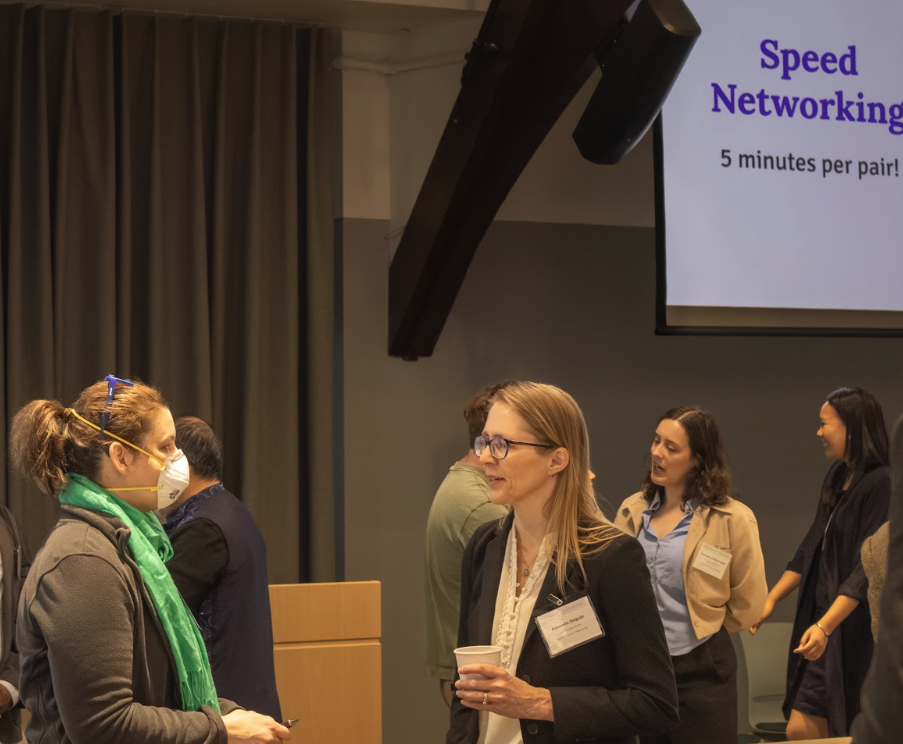
Morning: Journalism in Context
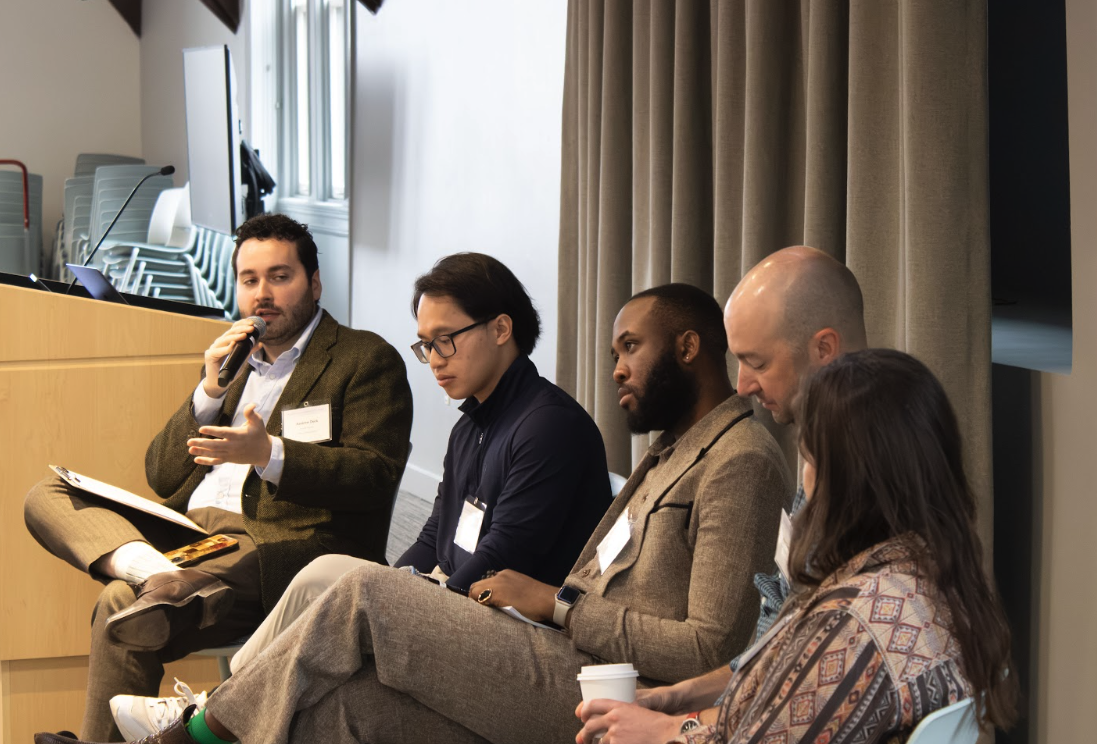
We opened with a panel of working journalists from newsrooms large and small — Duy Nguyen (New York Times), Marc Choquette (Boston Globe Media), Caleb Okereke (Minority Africa), and Lauren Feeney (Lexington Observer) — moderated by Andrew Deck (Nieman Journalism Lab). Panelists shared how their newsrooms are navigating AI adoption in practice, returning to recurring themes such as where to draw the line on AI-assisted writing, what disclosure should look like, and what collective approaches might offer for protecting journalistic IP at scale.
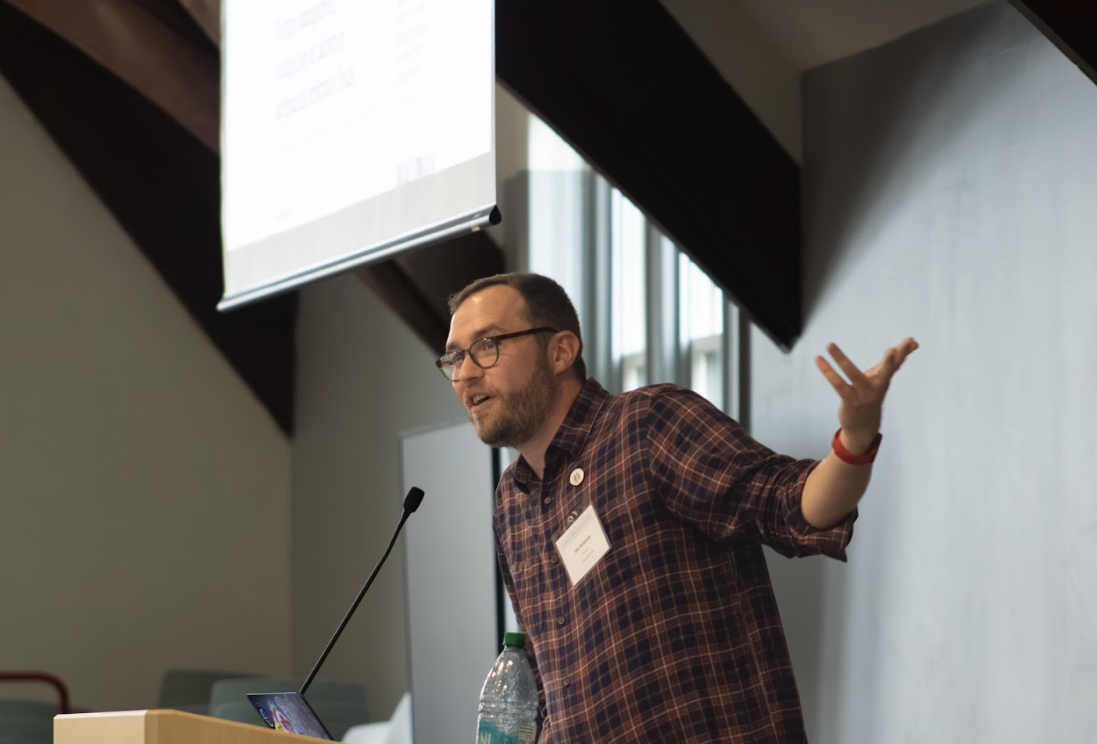
Jon Schleuss, president of the NewsGuild, then gave a keynote on labor's ongoing fight for ethical AI protections in newsrooms across the country. Jon opened by highlighting the NewsGuild's concrete gains, including holding 99 strikes in five years and securing AI-related provisions—such as using AI for assistance, not generating original work—in 67 collective bargaining agreements. He left the room with challenging provocations: can we bring in enough newsrooms to make a collective effort worthwhile? How fast should we move without sacrificing credibility? And how can a path forward center journalistic ethics?
Afternoon: Levers of control
The afternoon sessions featured lightning talks focused on what it would take to build a community-led option for AI in news, with sessions structured around different “levers of control.”
The first set of lightning talks explored technical levers, bringing conversations about data quality, privacy and evaluation to the journalism context. Shayne Longpre (MIT) spoke to the data underpinning AI systems, and how these sources are shifting with rising paywalls and exclusive contracts; Stephan Rabanser (Princeton) laid out options for where AI should run and how to weigh them given privacy concerns; and Hilke Schellmann (NYU) raised concerns about “vibe check” evaluations, arguing for more rigorous, expert-informed benchmarking processes.
The second set of lightning talks turned to governance structures, asking what organizational forms could support long-term community control. R. Trebor Scholz (The New School) introduced the concept of platform cooperativism, making the case for worker-owned AI infrastructure and governance; Sohyeon Hwang (Princeton) highlighted models of decentralized community governance in online communities; and Joshua Tan (Metagov) spoke to the idea of “public AI,” drawing analogies to other forms of public infrastructure.
Unconference session
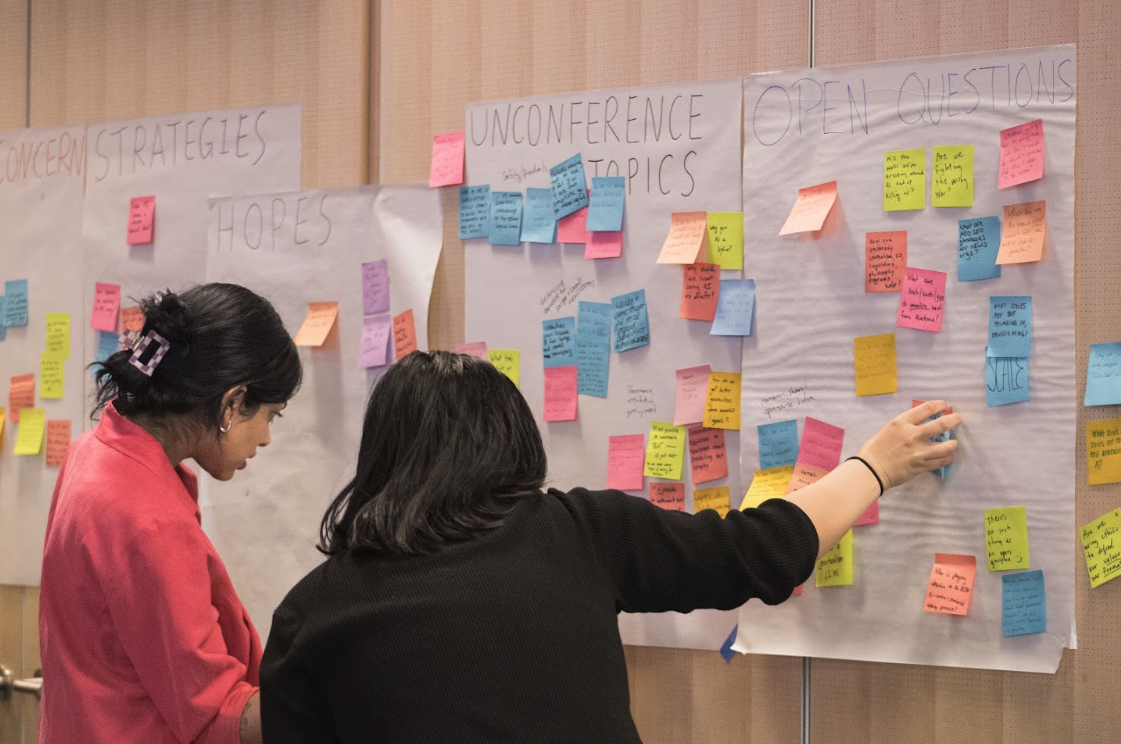
The day closed with a participant-led “unconference” session. Throughout the morning and afternoon, participants added their hopes, fears, concerns, and strategies to Post-its. In the final hour, we clustered these into eight key themes, including creating cross-disciplinary collaborations between journalism and academia, building shared open-source infrastructure, and balancing benefits for large and small newsrooms. Participants organically gathered in small groups to identify concrete next steps for each topic.
Takeaways
Reflecting on the workshop, a few threads stood out. Much of the day’s discussion spoke to the value proposition of journalism, and a strong desire to preserve the fundamentally “human” aspects of the job. Participants highlighted how trust and credibility are built over time through community relationships and on-the-ground reporting that no AI tool can replicate. The idea that AI should not be writing audience-facing stories was a commonly-held tenet across different newsrooms’ AI policies.
At the same time, participants agreed on the promise of near-term applications of AI to more “rote” work — processing large data releases, managing public records requests, querying internal databases. But the distinction between the “human” and “rote” work is not always straightforward: as was discussed in one unconference group, the lines between research and writing are often blurred, and may vary depending on the context. Looking forward, we’re interested in better understanding the nuances in where these boundaries lie, and what kinds of concrete guardrails or governance mechanisms can ensure that they’re followed.
A second theme centered around opportunities and challenges of building shared AI infrastructure for the journalism industry. Participants were interested in tools that could be designed for collaboration and shared across newsrooms. The open-source LLM wrapper LibreChat — a chatbot interface that can be connected to a newsroom’s proprietary archive and given custom instructions — was raised as an example of modular, “plug and play” infrastructure that is more tractable to build and adopt than fully independent, in-house models.
Strengthening the organizational layer was brought up as an equally important precondition for getting shared technical infrastructure to work, particularly given the fragmented landscape of journalism. Participants spoke about coalition-building and strategies for shared governance, highlighting bottom-up approaches that bring stakeholders together and let ideas emerge. Some of this organizational infrastructure already exists: collective bargaining agreements have increasingly included AI-related provisions, offering one model for how shared standards might take root across the industry. The roles that different organizational structures — from labor unions to professional associations or new technical coalitions — might play in supporting shared technical infrastructure and governance remains an open question that we’re eager to continue figuring out. Longer-term investments into more ambitious technical infrastructure (e.g., purpose-built models owned by newsrooms) may also become more viable as these organizational foundations strengthen.
More broadly, we’re working to map out “levers of control” that can be harnessed by practitioners and publics in our current AI era. What kinds of organizational controls (e.g., worker-led AI policies), technical interventions (e.g., domain-specific benchmarks), or ownership models (e.g., AI/data cooperatives) might shift the concentration of power across the AI pipeline? The workshop was an opportunity to stress-test these ideas in a real-world context, and the journalism industry's particular mix of technical, labor, and organizational challenges helped concretize the tensions of specific approaches. While journalism was our focus, we believe these questions are urgent for any domain grappling with how to maintain meaningful control over AI systems that increasingly shape public life.
Looking forward, we're planning to share more about where we think the field might go from here in a longer writeup. For now, we're grateful to all who joined us, to our wonderful staff and student volunteers, to the Center for Technological Responsibility, Reimagination, and Redesign (CNTR) and to the Brown 2026 committee for their generous support. Brown 2026 is a campus-wide initiative dedicated to exploring the role of research universities in fostering open and democratic societies, a mission that resonates deeply with our goal for the workshop: ensuring that journalism, a cornerstone of democratic life, remains thriving, independent, and publicly accountable.
Acknowledgements
Student volunteers: Ahana Bhattacharya, Alyssa Lanter, Karina LaRubbio, Matthew Bilik, Michelle L. Ding, Sharanya Jain, Sybille Légitime, Yujia Gao
Staff support: Dawn Reed, Lauren Clarke, Meredith Mendola
Photo credits: Karina LaRubbio, Yujia Gao