Computer Science and Sociology, Class of 2026.5
Data Science Institute
Center for Technological Responsibility, Reimagination and Redesign
Date
August 11, 2026
CNTR AISLE’s Inaugural Cohort: A Reflection
From January 19th to May 26th, 2026, I had the pleasure of co-running the first cohort of the CNTR AISLE Legislation Lab alongside Dre Boyd-Weatherly (‘26). As we continue into our second cohort this summer, I wanted to take a brief moment to pause and reflect on the lab’s journey of success, growth, and iteration thus far.
What is CNTR AISLE?
Over 1,000 AI-related bills have been introduced across the United States since January 2023. This surge has made it challenging to zoom out and identify key elements of AI legislation, leaving the public without a clear way to make sense of a fast-moving policy landscape.
We built the CNTR AISLE Framework in response to this gap, helping policymakers, journalists, researchers, and the public identify key policy trends and assess the maturity of AI legislation. To do so, we start by collecting a database of AI-related bills from federal and state governments. From there, each bill is evaluated across seven governance dimensions, including accountability, data protection, bias, labor, institutions, education, and synthetic content. That evaluation feeds into a bill profile that highlights concrete requirements, rights, and obligations, alongside a spider graph that visualizes the bill's regulatory coverage. Learn more about our methodology here.
The Legislation Lab is a crucial powerhouse behind the project. Twenty-five student scorers from diverse backgrounds, including computer science, data science, policy, and AI, read and score bills in the CNTR AISLE portal using our rubric.
12 Weeks, 25 People, 136 Bills
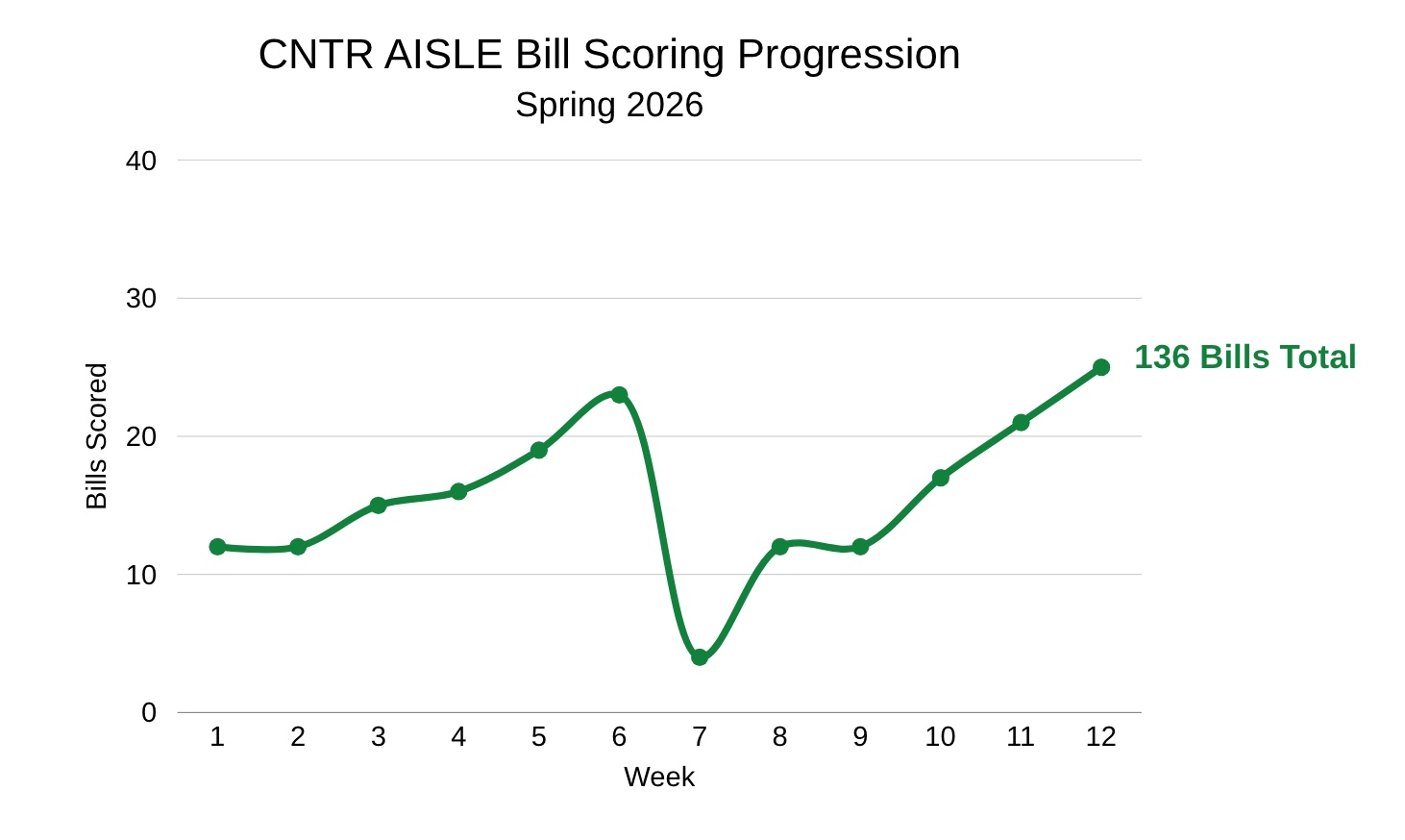
After a first week of training and practice bills, we launched our inaugural cohort in January of 2026. Collectively, we scored 136 bills over the course of 12 weeks, with each scorer averaging 2 bills per week. We split the group into advanced scorers (graduate students) and undergraduate scorers to provide a balance of perspectives. Each bill counted as "scored" once it had a minimum of 1 graduate and 2 undergraduate scorers.
It was a privilege to work with such motivated, organized, and sharp legislation lab members. Their insightful feedback and shared journey of curiosity made the process innately human and rewarding. I had great conversations with scorers that led to iterative changes in our methodology along the way. As an indicator of our mutual enjoyment, 14 returning scorers reapplied and joined our summer cohort, continuing their work with us. In this new cohort, we've been tackling longer bills and plan to increase our database of bill profiles.
“ I've really enjoyed the way that AISLE has taught me to understand AI legislation in terms of patterns. Patterns in definitions, patterns in priorities, and patterns in overall bill structure. ”
Aside from managing the lab, a large part of my role was monitoring and staying up to date with AI bills, keeping us at the forefront of this fast-moving space. I ended the semester feeling inspired by bubbling legislation being proposed across states, but also by the people dedicating time to meticulously read and analyze them. AI policy is a new and dynamic space, constantly responding to changes in technical innovation, legal disputes, corporate incentives, and the lived experiences of Americans. Given the federal government’s current lack of a comprehensive AI policy, the onus for legislating our future has fallen onto state-level government. CNTR AISLE’s work ensures that these important policies don't stay stuck behind legislature doors, and are accessible to the people they most affect. The first step to re-imagining our reality is to understand it, and CNTR AISLE helps do just that.