
Data Science Institute
Center for Technological Responsibility, Reimagination and Redesign
Date
October 30, 2026
New Interactive Website Maps the Technology Ecosystem Behind Deepfake Abuse
Content Warning: This article includes discussions of image-based sexual abuse and gender-based violence, specifically AI-generated non-consensual intimate images
In today’s rapidly evolving AI landscape, artificial intelligence is increasingly being used to cause harm; one example is the creation of AI-generated non-consensual intimate imagery (AIG-NCII).
A new project, NCII-ECOSYSTEM.ORG, aims to broaden that conversation. Developed by Michelle L. Ding, Haya Bugshan, and Maja Mishevska, the website transforms Michelle's research by mapping the technological infrastructure behind deepfake abuse into an interactive story and searchable database. By making the research accessible beyond academic audiences, the team hopes to help researchers, journalists, policymakers, advocates, and the public better understand the systems that enable this harm.
The project builds on two years of research by Michelle and her Ph.D. advisors and co-authors, Harini Suresh and Suresh Venkatasubramanian. The resulting paper was published in 2026 and is slated to appear at the ACM Conference on Equity and Access in Algorithms, Mechanisms, and Optimization (EAAMO ’26) in Munich, Germany, where Michelle is scheduled to present on November 7.
For Michelle, publication was only the beginning.
“It was easy to stop here – at the publication. But with an issue as widespread and urgent as deepfake abuse, I wanted to make sure that my paper mapping the tech ecosystem was translated into a medium that is accessible, creative, and useful to other communities so it could actually make an impact,” she explained.
Going Beyond the Perpetrators
When researching this topic, Michelle found that over 90% of U.S. state laws criminalize an individual rather than the technologies enabling harm. This statistic led her to realize a noticeable gap. While individual accountability remains important, it does not fully address the scale or complexity of the problem, particularly as technology allows harmful content to be generated and distributed at scale through interconnected platforms and services.
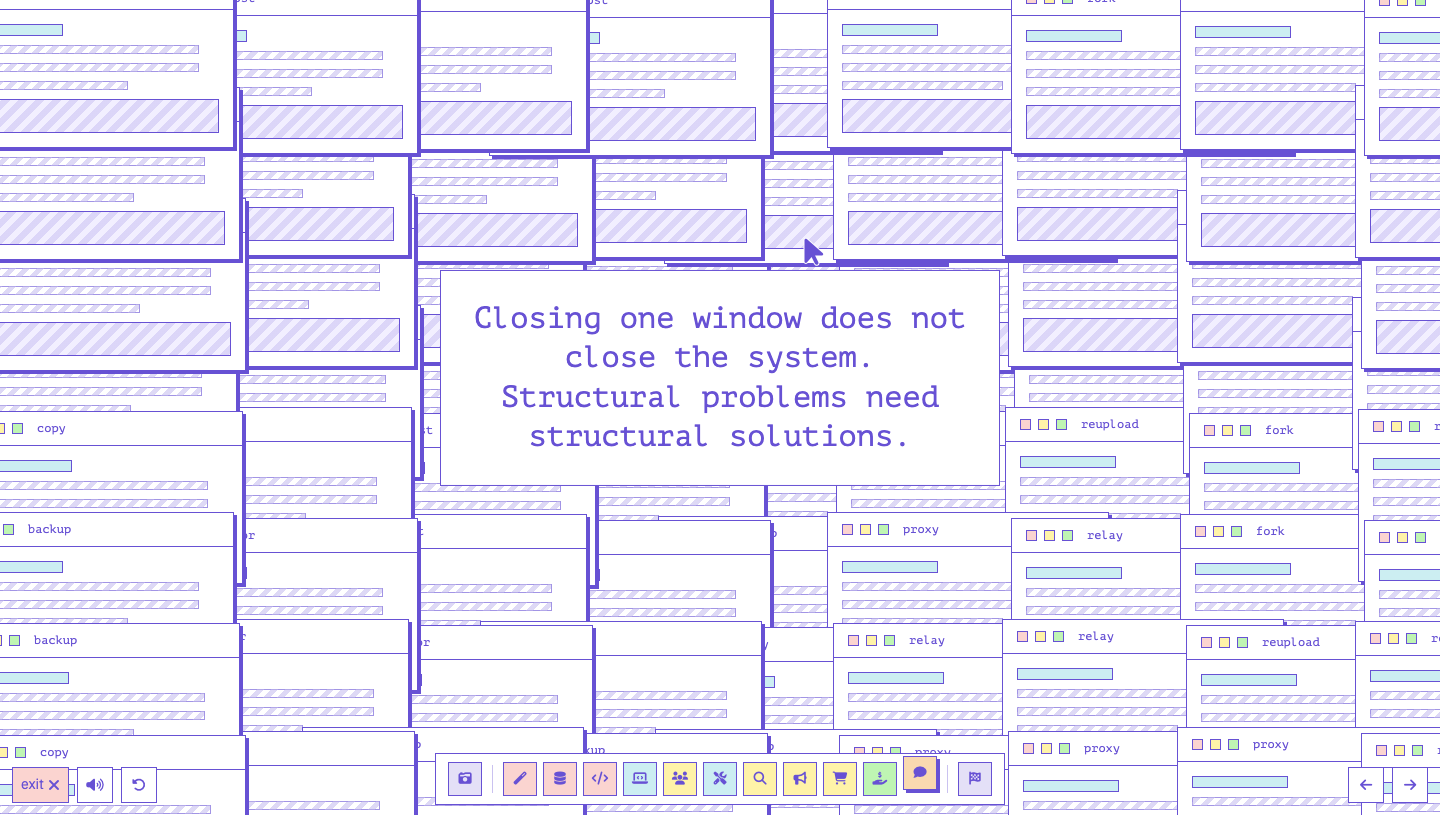
Michelle emphasized that deepfake abuse is enabled by an interconnected network of AI models, websites, apps, payment processors, and social media advertising. Shutting down one service often fails to solve the problem, as another can quickly take its place.
The team describes this cycle as a “whack-a-mole” problem. Focusing on individual perpetrators, apps, or websites without addressing the broader infrastructure allows abuse to quickly reappear and persist.
“Deepfake abuse is not just a single image, model, website, or app. It's an entire ecosystem. To prevent abuse, we need to first see the ecosystem clearly.”
PhD Student in Computer Science, Affiliated with CNTR

NCII-ECOSYSTEM.ORG makes these connections visible to encourage a broader approach to accountability and prevention.
Turning Complex Research into a Conceptual Interactive Experience
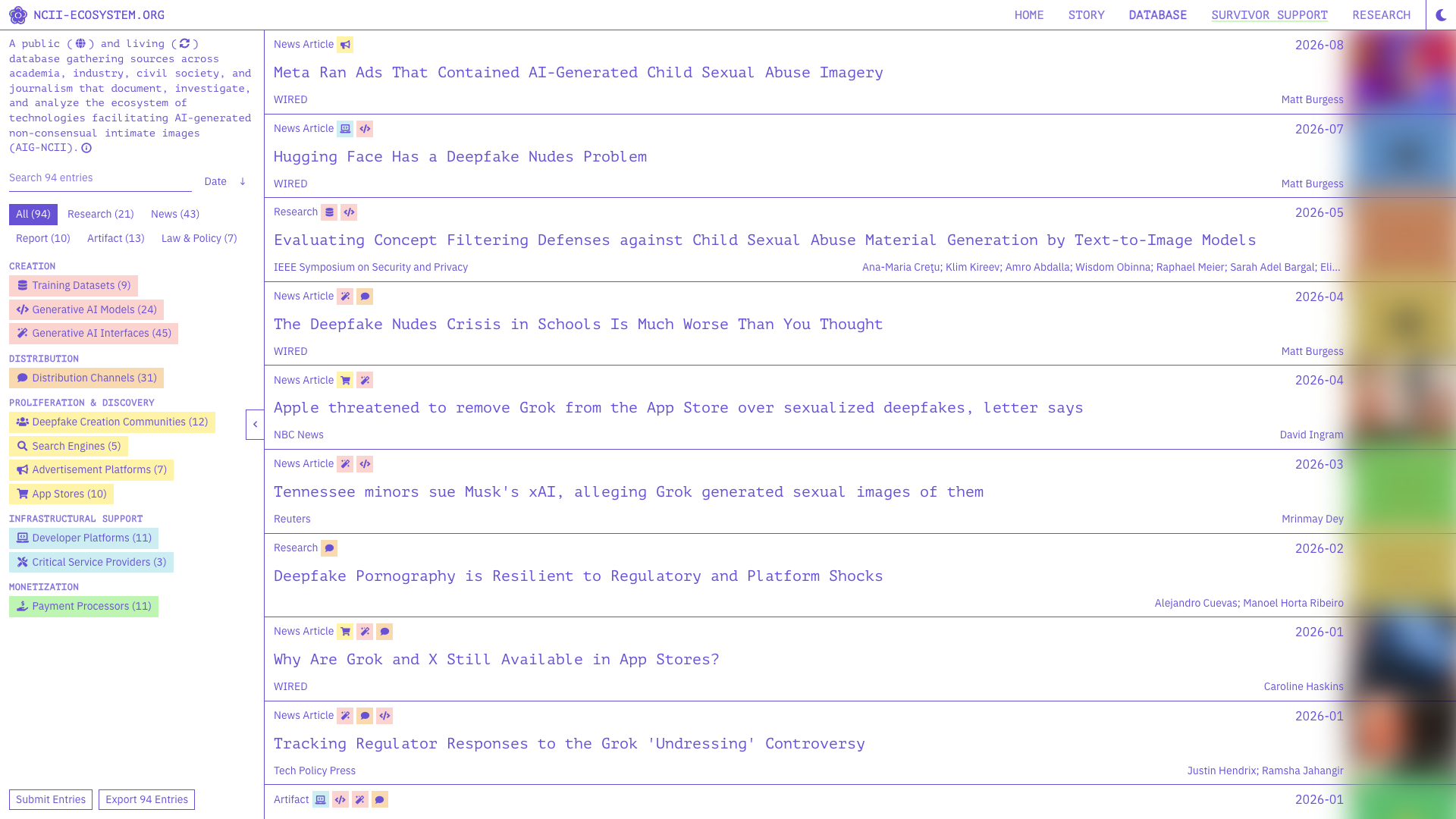
When on NCII-ECOSYSTEM.ORG, there are two primary ways of exploring the research. One way is an interactive story, made for a general audience, and the other is a searchable database made for researchers, journalists, advocates, and policymakers.
The story guides visitors through the technologies connected to deepfake abuse, while the database allows users to explore information and export search results for further analysis.
Haya explained that the interactive format makes an abstract technological ecosystem more comprehensible by connecting it to familiar tools and websites. She wanted to create an experience that would allow readers to engage with the material and develop an understanding of the ecosystem for themselves, rather than simply being told what it was.
The process of translating that complexity into an accessible experience presented its own challenges.
“One of the biggest challenges was figuring out how to communicate that complexity without overwhelming the reader or oversimplifying the research. How do you take something that is so sprawling and interconnected and make it tangible and understandable to someone encountering it for the first time, while still doing justice to the research itself? By presenting these technologies as recognizable tools and websites that people encounter in their everyday lives, the interactive format makes the ecosystem more tangible. Which I think makes the research more accessible and easier to understand.”
Undergraduate Student in Computational Neuroscience and Applied Mathematics

The interactive story also changes how readers encounter the main issue. Rather than stopping at an individual incident, perpetrator, or AI tool directly involved, the experience steadily reveals the additional companies and technologies connected to the bigger issue.
Maja added that gradually revealing these connections encourages readers to look beyond individual incidents and reconsider where responsibility lies. By allowing visitors to trace these connections at their own pace, the website encourages them to look beyond the most visible culprits and consider the broader technological systems that enable the ongoing abuse.
Designing the Website with Care and Accountability
The team aimed to make complex research accessible while treating a sensitive subject with care. Rather than relying on survivors’ personal experiences or reproducing harmful imagery, the website focuses on the broader technological systems that enable AI-generated non-consensual intimate imagery (AIG-NCII). This approach shifts attention from individual acts of abuse to the conditions that make it possible, raising questions about where responsibility and accountability lie.
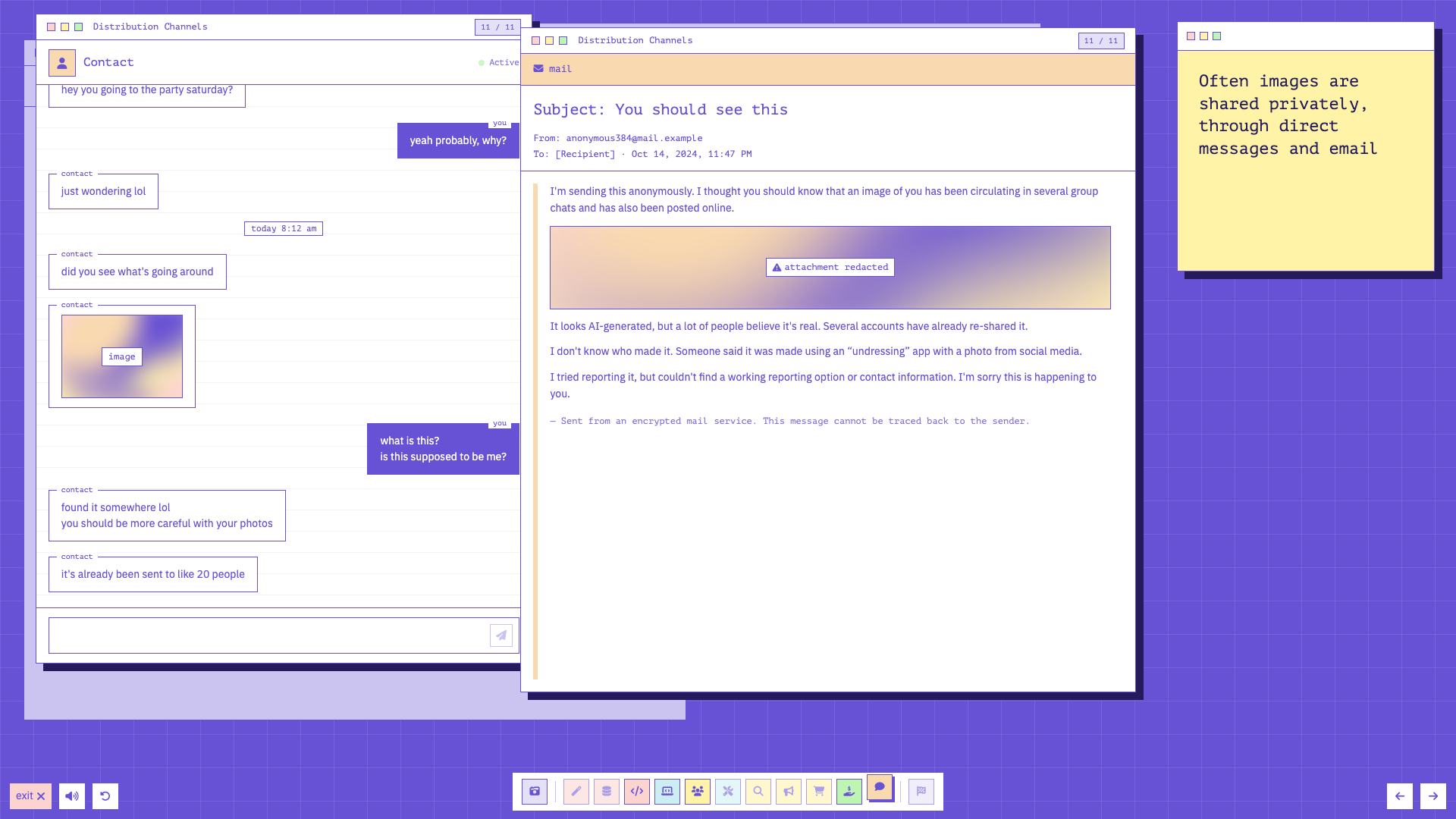
Haya wanted the immersive experience to help readers develop their own understanding of the ecosystem while conveying the complexity of investigating it. Pop-up windows and news headlines give visitors a sense of the volume of information and the many interconnected threads involved in understanding the issue.
Maja focused on creating a consistent design approach across the website’s various components, including the interactive story, database, survivor support resources, and research page. From the logo and color palette to the typography and icons, she wanted each element to feel like part of the same project while still serving its own purpose.
“I think one thing I kept coming back to was that design is never neutral, especially with a sensitive subject like this. A big part of my focus was creating a cohesive visual identity across the website’s different components, while allowing each to serve its own purpose. Above all, I wanted the website to feel approachable and thoughtfully designed, rather than like an academic paper that had simply been pasted online.”
Undergraduate Student in Computer Science and Gender and Sexuality Studies

That philosophy also shaped the website’s recurring blur effect, which references the visual language surrounding AIG-NCII without displaying victims’ experiences for shock value. Instead, the design communicates the seriousness of the issue while directing attention toward the technologies and systems enabling the harm. As Maja put it, “You don’t need to put someone’s suffering on display to communicate the seriousness of the issue. The infrastructure enabling the harm deserves scrutiny in its own right.”
Bringing Together Research, Design, and Technology
The website combines Michelle’s research with Haya’s digital storytelling and development work and Maja’s database development and visual design. Haya developed the concept for the digital story, built the experience, created the research page and accompanying figures, and compiled the project’s initial list of resources. Maja developed the database, built and curated the survivor support page, and led the website’s overall design, creating a distinctive aesthetic across its different sections through the layout, typography, colors, and other elements. She also contributed to the storyboard and helped refine the storytelling experience.
Each team member brought a distinct perspective to the project. Haya, whose background is in computational neuroscience and mathematics, focused on making complex research accessible without losing its depth. Maja, a double concentrator in Computer Science and Gender and Sexuality Studies, drew on her sociotechnical research on technology-facilitated abuse and gender-based harms to inform her approach to the website's structure, presentation, and user experience.
Supporting More Informed Prevention Efforts
The team hopes the website will help policymakers, journalists, technology companies, and advocacy organizations better understand the systems involved in AI-generated non-consensual intimate imagery (AIG-NCII) and identify opportunities for prevention. Its engaging map of U.S. intimate deepfake laws allows policymakers to compare state regulations, identify gaps in how technologies are addressed, and work toward more consistent legal approaches.
The interactive story offers another way to understand the ecosystem by revealing the technologies connected to individual incidents. As Michelle explained, news coverage may focus on a single tool, such as Grok, while overlooking the other technologies involved, including app stores, payment processors, AI models, and user interfaces. By making these connections visible, the story encourages journalists, advocates, and the public to consider the broader systems that enable abuse.
Looking ahead, the team hopes to establish partnerships across journalism, civil society, policy, and industry to maintain the database as the ecosystem evolves. By helping users compare laws, identify regulatory gaps, and trace the technologies involved in abuse, the project provides a foundation for more targeted prevention efforts and a clearer understanding of where accountability may lie.

Making Research Useful Beyond Academia
NCII-ECOSYSTEM.ORG demonstrates how academic research can become an accessible, practical resource. By combining interactive storytelling, a searchable database, and thoughtful design, the project encourages people to examine the systems enabling deepfake abuse and consider broader approaches to accountability and prevention.
The project's broader significance also lies in creating opportunities for people outside academia to engage with research, explore its findings, and use them to better understand the world around them.
“I think it’s becoming increasingly important to find ways to democratize research and create opportunities for the public to engage directly with the work researchers are doing. Research shouldn’t necessarily stay behind academic paywalls or within academic circles; it should be something people can access, explore, and use to develop their own understanding of the world around them. At a time when trust in institutions and research can feel increasingly fragile, I think finding meaningful ways to make research more accessible, transparent, and engaging is an important part of rebuilding that trust,” Haya explained.
Explore the project at NCII-ECOSYSTEM.ORG
Explore the research at https://arxiv.org/pdf/2602.04759